World war ii monuments
Pearl Harbor U.S.S. Arizona Memorial
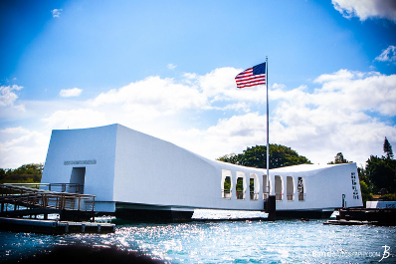
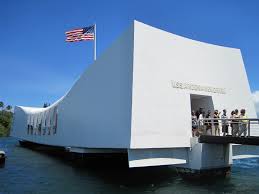
Figure 1.1 & 1.2: USS Arizona Memorial
World War II Valor in the Pacific National Monument preserves and presents the stories about the Pacific War including : events at Pearl Harbor, the internment of Japanese Americans, and the invasion of Japan. The USS Arizona is the final home for many of the ship's 1,177 crewmen who lost their lives on December 7, 1941. The memorial structure has a 184-foot-long span with the mid-portion of the sunken battleship. It consists of three main sections: the entry room; the assembly room, a central area (designed for ceremonies, general observation, and a shrine room, where the marble wall of engraved names of all those that had been killed on the Arizona).
The USS Arizona Memorial was established as a memorial at Pearl Harbor to honor those who died in the attack. The first time the memorial was brought up was in 1943, but it wasn't until years later in 1949, when the State of Hawaii established the Pacific War Memorial Commission. After the Commission was made the first real steps were taken to bring the monument to life. In fact President Dwight D. Eisenhower, approved the creation of the Memorial in 1958. Which lead to its construction, then completion in 1961; with public funds collected by Congress and private donations. The Memorial was finally dedicated in 1962.
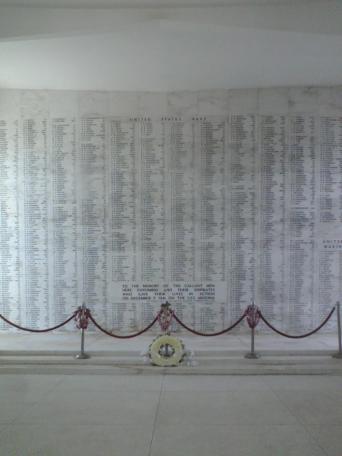
Figure 2: List of American Naval individuals killed during Pearl Harbor
Each year, the USS Arizona Memorial welcomes about 1.4 million visitors from all around the world. It accommodates every person no matter what. Even though this is a memorial for those Americans that lost their lives at Pearl Harbor, a lot of others pay their respects for what has taken place. World War II veteran speakers come and leave their marks on those that visit in hopes that nothing like this occurs again.
Fun Fact: According to Alfred Preis, the architect, the reason the structure sags in the middle and stands strong at the ends is to express the initial defeat and then victory of World War II. It is supposed to leave all that visit with a feeling of serenity and allow them to really think about their innermost feelings.
Hiroshima Peace Park
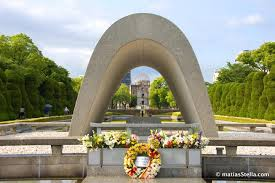
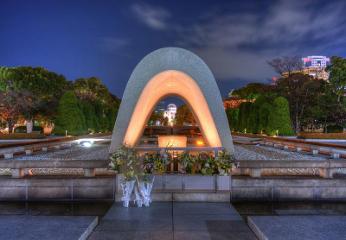
Figure 3.1: The Memorial Cenotaph Figure 3.2: The Memorial Cenotaph with Peace Flame
On August 6, 1945, the first atomic bomb in history was dropped directly over Hiroshima. Nearly all life was wiped out as the entire district vanished instantly. On August 6, 1949, the Hiroshima Peace Memorial City Construction Law, was made and it decided that the entire Nakajima District would be devoted to "peace memorial facilities.” That was the beginning of Peace Memorial Park.
The park covers approximately 122,100 square meters. There are three main buildings: the East Building and the Main Building of the Peace Memorial Museum, and the International Conference Center Hiroshima. It is comprised of about 30 total peace monuments and structures, such as the Memorial Cenotaph, Peace Flame, Peace Bells, Atomic Bomb Memorial Mound, and Hiroshima Peace Memorial. The park was designed by Kenzo Tange, a professor at Tokyo University, whose proposal was selected through a design competition that had a total of 145 proposals. Approximately 1.5 million people visit the Peace Park per year.
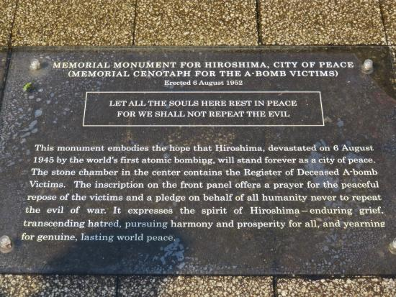
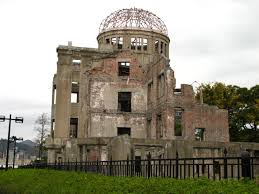
Figure 4.1: Plaque displayed for the A-Bomb Dome Figure 4.2: The A-Bomb Dome
The Hiroshima Peace Memorial (Genbaku Dome) is the only structure left standing near the site of the first atomic bomb which exploded on August 6, 1945. Additionally, it remains in the condition since right after the explosion. Through the efforts of many people, including the whole city of Hiroshima, this ruin site has been preserved in the same state as it had been immediately after the bombing. Not only is it a powerful symbol of the most destructive force ever created by humankind, it also expresses the hope for world peace and the ultimate elimination of all nuclear weapons.
References
"National Park Service." History and Culture. 2015. Web. 4 June 2015
<http://www.nps.gov/valr/learn/historyculture/index.htm>.
"Guided Tours to Peace Memorial Park and Vicinity." 2015. Web. 4 June 2015
<http://www.pcf.city.hiroshima.jp/frame/Virtual_e/tour_e/guide1.html>.
This project was conducted by Bianca Fregoso, Courtney Romero, and Rose Rodgers for our History 80Y class.
